
AI-Techno Jinni: Wished for a demo product, now what?
An interactive navigation demo made an idea tangible—and exposed the evidence I still need before deciding whether it deserves to become a product.
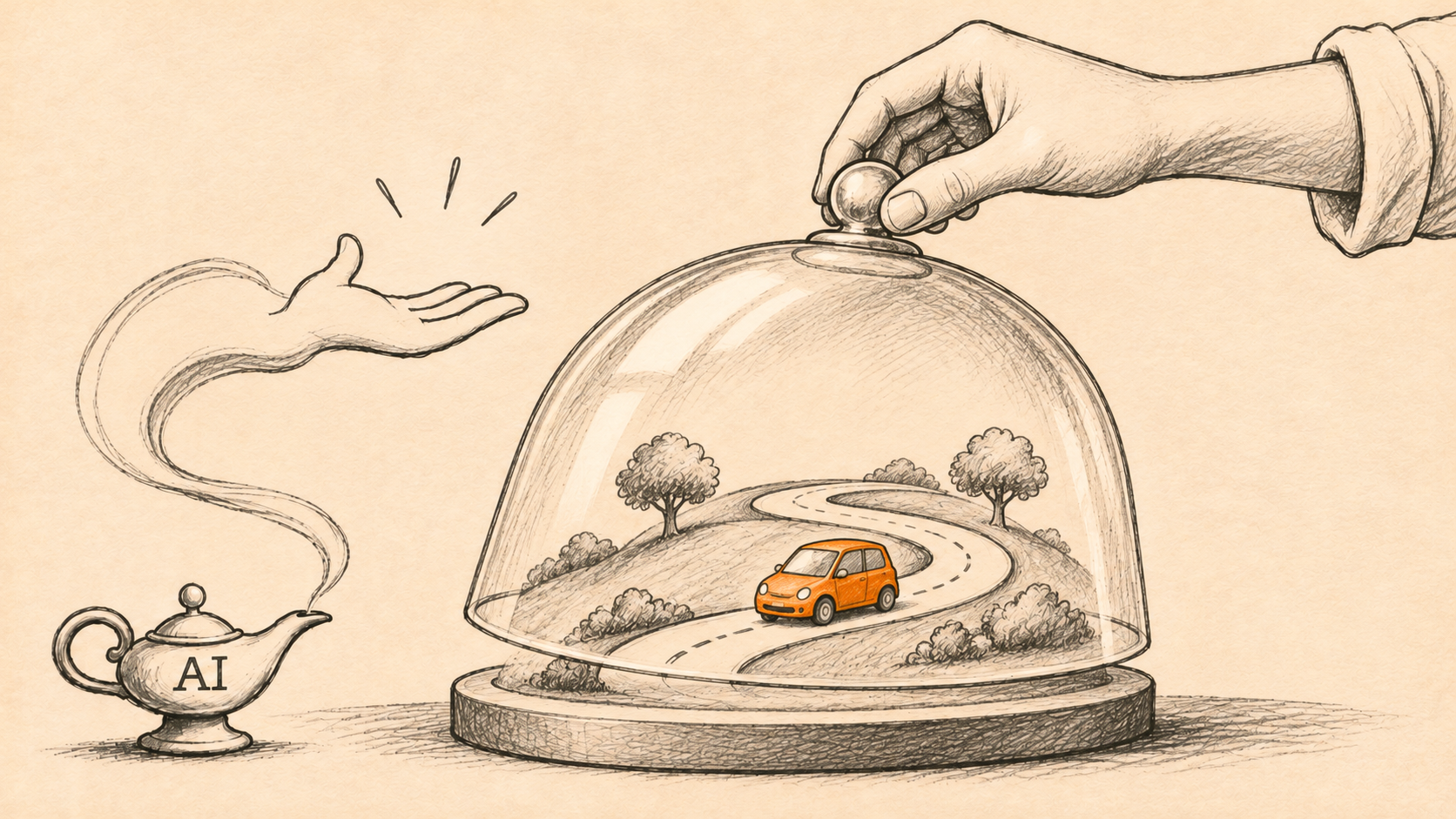
One of the most satisfying wishes I can give my AI Jinni is: “Show me.” Not another explanation of how an idea might work. Something I can actually click, move around and react to. It's remarkable how quickly an idea can start looking like a product once it's on a screen.
I had that feeling while working on an interactive navigation demo. I wanted to see a route, a moving vehicle and an estimated arrival time instead of talking about how those things might eventually fit together. AI helped turn the idea into something I could inspect. That was genuinely useful.
Then I started using the demo rather than just looking at it.
A route line that seemed fine at first could break or disappear. The vehicle could move while its arrival estimate stayed stubbornly unchanged. Some controls were present, but their purpose wasn't necessarily obvious to someone looking at the screen for the first time. The individual pieces were there; they didn't always tell the same story.
We revised the demo. The route needed to remain connected, the movement and timing needed to make sense together, and the controls needed to be understandable without a running commentary from me. Each correction made the idea easier to see—and exposed another assumption I hadn't noticed when it was just a description.
Eventually, I had a more convincing demonstration. And then came a question the first wish hadn't answered: now what?
The demo had done something valuable. It gave me a concrete thing to examine and a much clearer way to discuss the idea. But I had been looking at behavior under conditions chosen for a demonstration. I hadn't established what would happen with representative real-world data, how unfamiliar users would work with it, what needed to be reliable, or what it would take to support it outside that controlled setting.
Those are not defects a polished screen can resolve by looking polished. And making the demonstration more elaborate wouldn't automatically answer them.
That was the more interesting realization: I had stopped wondering whether AI could make the idea visible. I was now wondering whether the idea deserved to become a product.
Those are different questions, and they need different evidence.
The next useful step isn't necessarily another feature or a more impressive animation. It's establishing what the demonstration has actually shown and what remains unproven. Can the workflow handle representative inputs? Can someone unfamiliar with it complete the intended task? What happens when the information is missing, the route doesn't work or the estimate is wrong? And, most importantly, would solving those problems create enough practical value to justify taking the idea further?
I don't have all those answers yet. The demonstration doesn't establish them, and I don't want to pretend otherwise.
But that doesn't make the demo a failure. Quite the opposite.
I still love this part of working with AI. Something that might once have required too much effort just to explore can become tangible enough to challenge. The Jinni makes it easier to discover which parts of an idea are promising and which assumptions haven't survived contact with something interactive.
The first wish was “Show me.” The next is “Prove it's worth building.”
And the second wish might require something the Jinni cannot simply produce on demand: evidence from the real world.
Maybe that's the most useful thing the demo gave me. Not a finished product, but a much better understanding of what I would need to know before deciding to build one.