
If the same operational failure keeps recurring, the system has not really learned.
Recovering from a failure is useful. But if the same failure keeps demanding the same human correction, the workflow may have recorded the lesson without really learning it.
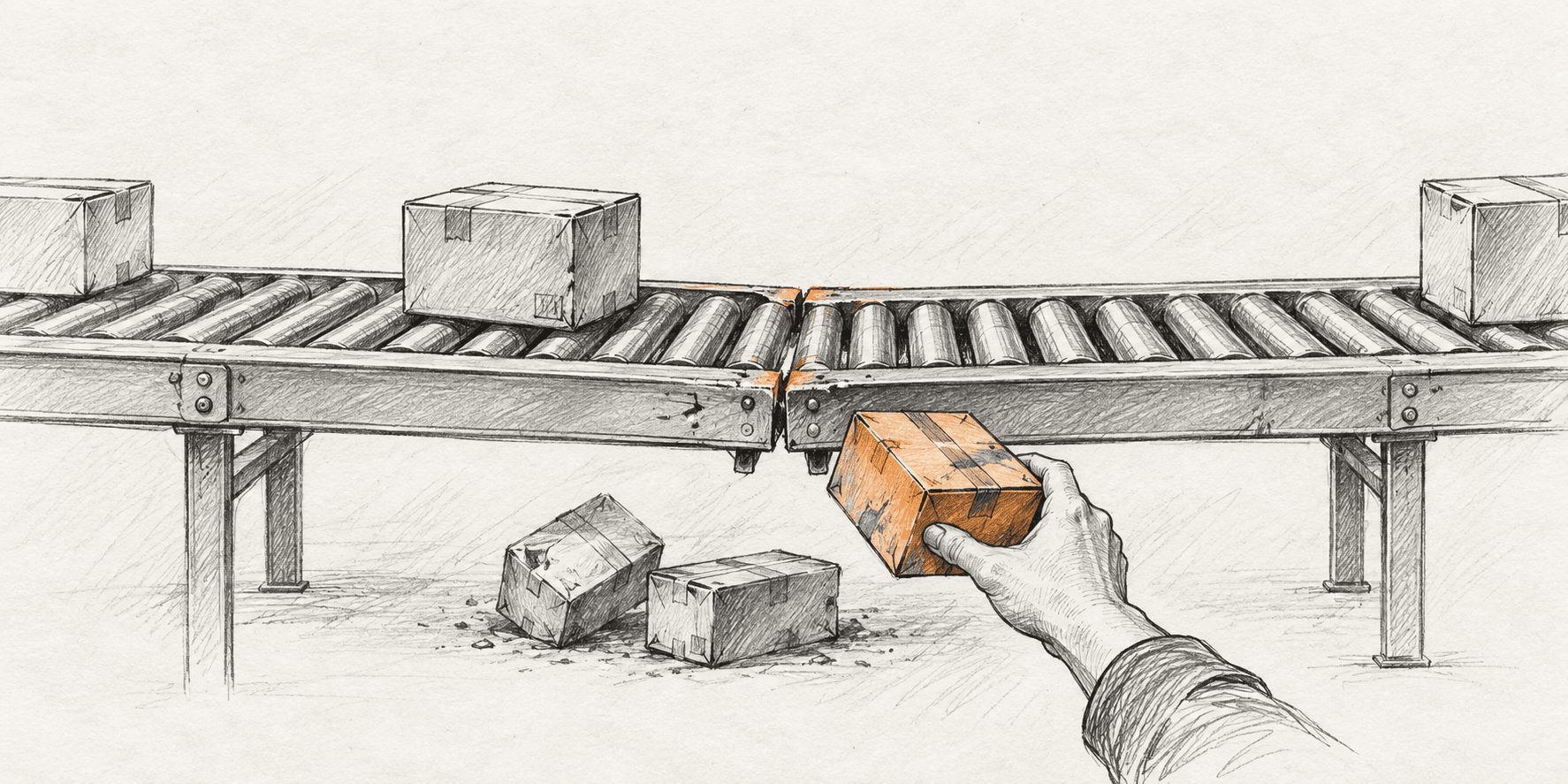
One of the easiest things for me to overestimate in product and development work is how much a system has learned from a failure. Something goes wrong, we investigate it, recover, write down what happened, make a correction and move on. From the outside, that can look like a complete learning loop.
In recent work, I kept seeing a less comfortable version of that story. A failure would be handled correctly enough in the moment, and the immediate problem would disappear. Then an adjacent path would expose essentially the same class of weakness again, sometimes with different symptoms and sometimes requiring the same kind of human intervention we thought we had already dealt with.
Nothing about the first response was necessarily wrong. Recovering mattered, the notes were useful, and the local fix often solved the problem that was actually in front of us. What changed my view was the recurrence: the evidence from the first failure had not changed future behaviour enough.
I have started using the word “learned” more strictly because of that. By system, I do not mean an AI model magically rewriting itself after every mistake. I mean the working system around the product: code, tests, automation, operating rules, handoffs, recovery paths and the humans who still have to make decisions inside them.
A lesson can exist in documentation without existing in that working system. I have had cases where the rule was already written down after an earlier problem. It was clear, reasonable and easy to explain, but the active workflow had no reliable way to apply it, so when a similar condition returned, someone still had to recognize it and intervene again.
That was a useful distinction for me. The knowledge existed, but the behaviour had not changed. The documentation had learned something; the workflow had not learned enough to make the lesson reliably reachable during normal work.
This is partly why I have become cautious about treating a post-incident review, root cause note or corrective action as proof that learning happened. Those things can be valuable, and I would rather have them than not. But they describe what we understood after the event; they do not automatically tell me what will happen differently during the next one.
Sometimes the right response really is a local fix. I do not think every defect or operational failure should trigger a broad redesign, and one incident is weak evidence for a sweeping conclusion. The problem starts when local corrections accumulate while the same underlying failure class keeps finding another way back into the workflow.
That is usually the point where I have to stop looking only at the visible symptom. The first failure may look like a bad condition check, the next like a routing problem, and another like a recovery issue. Only after seeing the pattern more than once does it become clear that several apparently separate problems are exposing the same missing protection or the same assumption that the system keeps making.
I also do not want to make recurrence too binary. The same kind of incident can happen again even after useful learning has taken place. If it is detected earlier, contained more safely, prevented from affecting another part of the workflow, or recovered from without repeating the same manual work, then the system may have learned something meaningful even though recurrence was not eliminated.
That matters because “prevent recurrence” can sound more absolute than real systems allow. Reliability is rarely the promise that a failure can never happen again. Sometimes the learning is that the failure becomes less likely; sometimes it becomes less damaging; sometimes it simply stops being surprising because detection and recovery now behave the way we intended.
The reverse is also true. Two incidents can look different on the surface while sharing the same causal weakness. If I patch each symptom separately, I can create a lot of visible activity without getting closer to the actual problem, which is one reason I have become more careful about declaring a root cause too early.
This has become especially noticeable in AI-assisted development workflows. Fast recovery can make a system look more mature than it is: an agent fails, a person gives it a correction, the work continues, and the task eventually completes. That is useful resilience, but if the same human has to provide essentially the same correction the next time, the workflow may be borrowing that person's memory rather than carrying the lesson itself.
I do not think the answer is to remove the human from every recovery. Some interventions genuinely require judgment, context or authority, and trying to automate those decisions would make the system worse. But when the intervention is deterministic and keeps repeating, I now treat that repetition as evidence that something probably belongs in the working path rather than in somebody's memory.
Sometimes that becomes a regression test. Sometimes it is a stronger check before an action starts, a safer route when a known condition appears, a changed default, or a recovery path that no longer depends on someone noticing the same thing again. The mechanism varies; what matters to me is that the lesson becomes encounterable by future work.
The hardest cases are often the ones where recovery is already good. If a system can recover cleanly, there is a natural temptation to call the problem handled, especially when development is moving quickly and the final outcome is successful. But a recovery path can hide an unresolved learning gap if the same failure keeps creating the same surprise, consuming the same attention and requiring the same correction.
That has changed the question I ask after recurring failures. I still want to know whether we recovered and whether the immediate defect was corrected, but I also want to know what will be different the next time this class of problem appears. If the only durable answer is “I will remember what to do,” then the learning is still sitting outside too much of the system.
I think this is a better way to understand continuous improvement as well. It is easy to measure improvement by the number of issues closed, rules written, postmortems completed or fixes shipped. Those are useful activities, but the stronger evidence is whether later behaviour reflects what those activities were supposed to teach us.
None of this guarantees a future with no recurring incidents, and I would not trust a process that promised that. The outcome I want is simpler: when a failure gives us reliable evidence, that evidence should leave some durable trace in how the system behaves afterward. If the same operational failure keeps returning with the same surprise, the same manual correction and roughly the same consequences, then we may have recorded the lesson without really learning it.