
A prerequisite can become the problem.
A legitimate prerequisite can grow into a mechanism whose own dependencies take over the work it was meant to support.
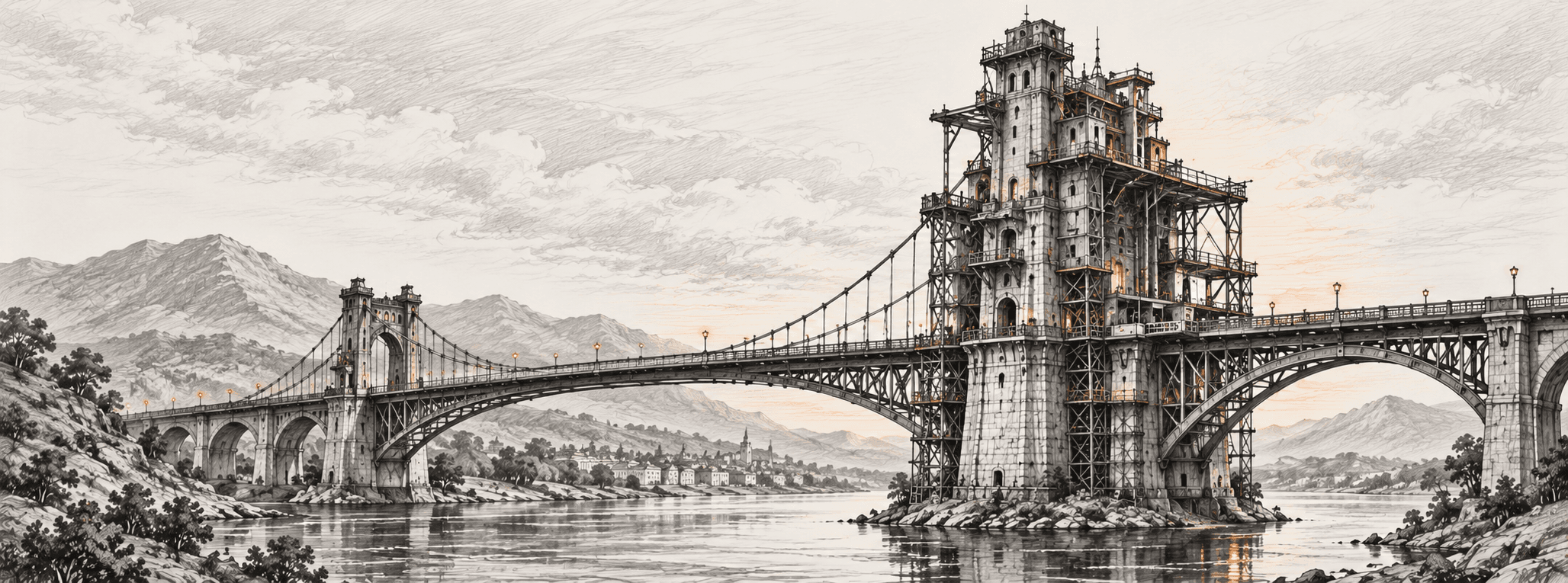
I recently found myself, while working with AI agents, spending more time making a prerequisite work than progressing the thing it was supposed to unlock. The prerequisite had been legitimate at the start. It solved a real problem, so the work around it felt justified. What changed was not the original need, but the amount of machinery that had accumulated around one particular way of satisfying it.
That is an easy trap in software development because dependencies are locally persuasive. The fact that I encountered it in that context did not make it an AI-specific problem: once an implementation direction is chosen, each new piece can become a prerequisite for the next. Inside that topology, the logic can be completely coherent: one component needs another, which needs another, so the whole chain starts to look like part of the critical path. The mistake is assuming that because the chain is internally valid, the whole chain is still required by the product outcome.
This distinction has become increasingly useful to me: something can be required by the current design without being required by the outcome itself. The first kind of requirement belongs to the problem we actually need to solve. The second may exist because of an architecture decision we made earlier. If I only inspect the current dependency graph, I can miss that difference because the graph faithfully explains why its own dependencies are necessary.
In the work that triggered this note, the prerequisite kept growing. It split into several pieces, each correction exposed another dependency, and progress on the original goal increasingly depended on finishing work that existed mainly because of the implementation already chosen. I did not catch the problem immediately because the individual engineering decisions were reasonable. That was the uncomfortable part: locally correct work was accumulating around the wrong causal boundary.
Eventually I had to ask a more basic question: what does the outcome actually require if I stop treating the current implementation as fixed? Once I looked at the problem from that level, a smaller route became visible. It did not remove the real constraints; it removed some of the accidental complexity introduced by the chosen solution. The important change was not “simplify everything.” It was to revalidate why each prerequisite was on the critical path in the first place.
This is not an argument for cutting corners, and it is not a way to use MVP or minimum viable scope as an excuse to ignore difficult engineering. Some blockers are genuinely causal. Safety, security, data integrity, recovery behaviour, acceptance evidence, and other core constraints do not become optional just because they make the implementation inconvenient. If a simpler architecture cannot preserve the outcome and the constraints that make that outcome valid, then it is not actually a simpler solution to the same problem.
Where overengineering becomes harder to notice is when implementation complexity starts generating its own justification. A mechanism grows, its internal software dependencies become real, and those dependencies are then used as evidence that the mechanism itself must keep growing. At that point, scope creep can hide inside perfectly rational dependency management. The work still looks disciplined when viewed one task at a time.
I now treat a prerequisite that starts becoming its own roadmap as a reason to re-check causality. The same applies when it repeatedly consumes corrective work or blocks progress that should be unrelated to its internal details. The useful question is no longer only whether the current mechanism can be completed. It is whether I would still choose that mechanism if I started again from the original outcome and the constraints that genuinely matter.
That has changed how I think about essential and accidental complexity in product development. Essential complexity belongs to the problem and has to be paid for somewhere. Accidental complexity may come from a reasonable design choice, but it should not quietly inherit the status of a product requirement simply because the current architecture depends on it. A prerequisite should help clear the path to the outcome; when maintaining the prerequisite becomes the path, it deserves to be examined again.